As one of the first medical device categories entering national centralized procurement, coronary drug eluting stents provide an interesting case study on how healthcare systems attempt to balance:
The proposed approach reviews 45 Sirolimus-coated stents from 35 manufacturers and 19 Everolimus-coated stents from 9 manufacturers, using a structured grouping methodology rather than relying on price alone.
What I find most interesting is that the discussion is no longer just about purchasing products.
It is increasingly about evaluating evidence. In this carousel, I’ve summarized: 📌 The key grouping principles 📌 The proposed Sirolimus and Everolimus subgroup structures 📌 How clinical evidence is incorporated into procurement design 📌 Why competition remains a core requirement across subgroups Swipe through the slides below 👇
💬 If you were designing a national stent tender, what should carry the greatest weight: clinical evidence, regulatory maturity, competition, or affordability?
Read full summarized document “Vietnam National Drug Eluting Stent Tender” here: https://lnkd.in/p/dFHBXvGC
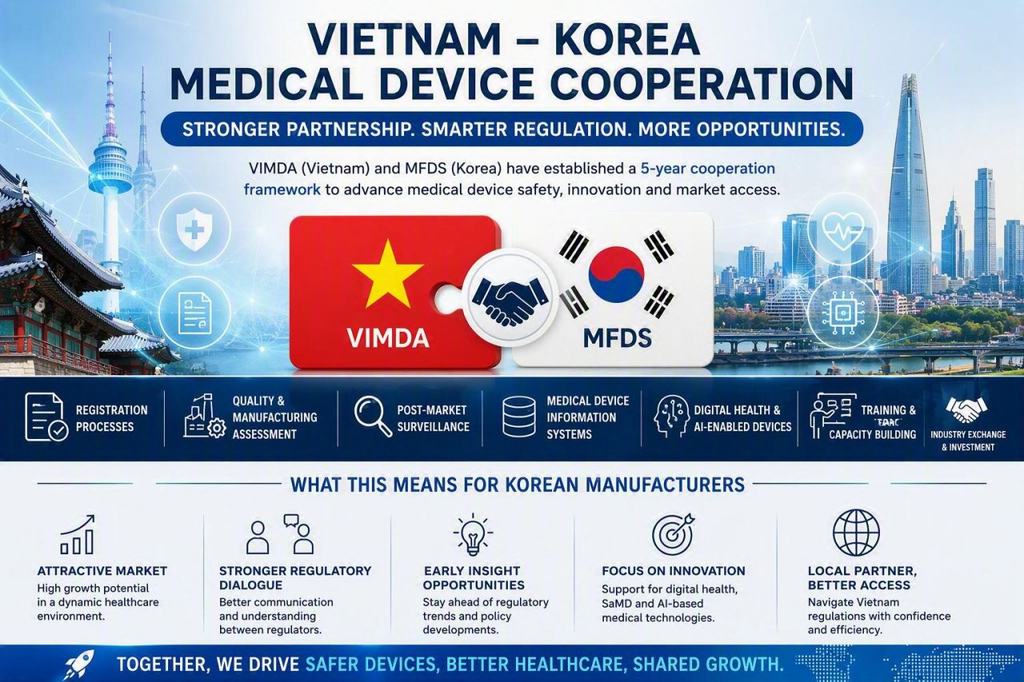
The recent cooperation framework between Vietnam’s Medical Device Administration (VIMDA) and Korea’s Medical Device Safety Bureau (MFDS) may not create immediate regulatory shortcuts, but it sends an important message to the medical device industry.
The agreement goes beyond a simple exchange program. It establishes a structured platform for cooperation covering medical device registration, quality systems, post-market surveillance, digital health technologies, AI-enabled devices, regulatory capacity building, and industry engagement.
For Korean manufacturers, this is encouraging for several reasons: ✅ Vietnam continues to demonstrate its commitment to regulatory modernization. ✅ Korean regulatory expertise is being recognized as a valuable reference in future capability development. ✅ Stronger regulator-to-regulator communication may improve transparency and mutual understanding. ✅ Emerging sectors such as Digital Health, Software as Medical Device (SaMD), and AI-based medical devices are now part of the formal cooperation agenda.
While this agreement does not provide mutual recognition or automatic approvals, it reinforces Vietnam’s position as an increasingly attractive and strategic market for Korean medical technology companies.
As regulatory systems mature and healthcare demand continues to grow, we expect more Korean manufacturers to explore expansion opportunities in Vietnam and seek local partners who can help navigate regulatory requirements, market access, and ongoing compliance.
The Vietnam medical device market continues to move toward greater sophistication, and this agreement provides another strong indicator of that direction.
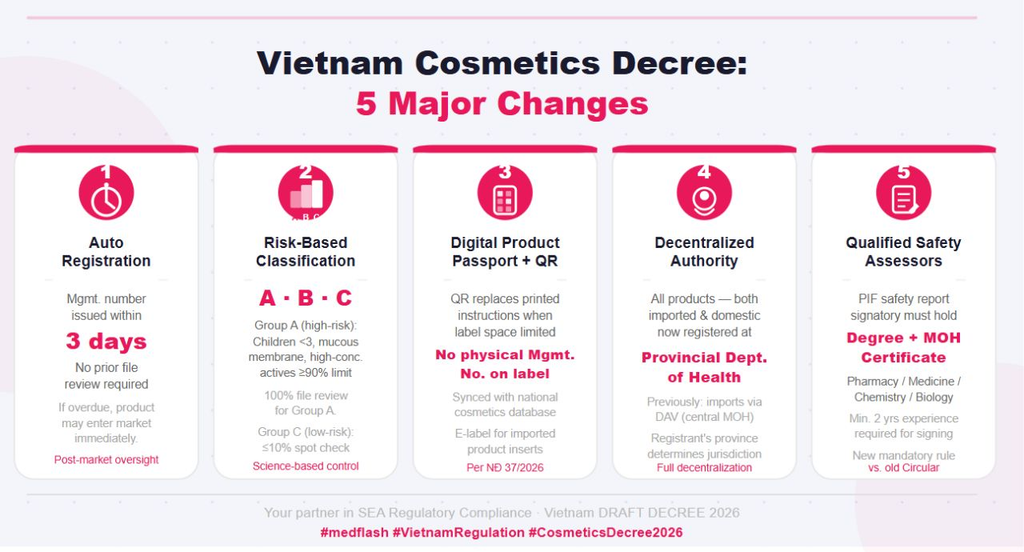
The MoH has released a landmark draft Decree on Cosmetics Management. This isn’t just a technical upgrade; it changes how products get registered, monitored, and marketed across Vietnam.
Here are the 5 changes that matter most:
1️⃣ FULLY AUTOMATIC NOTIFICATION: The new system issues a notification number within 3 working days. If the clock runs out, you can legally place your products on the market—no more waiting for official review.
2️⃣ RISK-BASED CLASSIFICATION (A/B/C): Lower-risk products enjoy lighter oversight, freeing up regulatory focus for high-scrutiny items like products for children under 3, products for mucous membrane contact, and high-concentration actives.
3️⃣ DIGITAL PRODUCT PASSPORT & e-LABELING: Embracing technology, QR codes can replace lengthy printed instructions, and notification numbers are no longer required to be physically printed on labels.
4️⃣ AUTHORITY SHIFTS TO PROVINCES: Registration is no longer a central process. Imported and domestically manufactured products will now be registered with the provincial Department of Health instead of the central Drug Administration of Vietnam (DAV).
5️⃣ CREDENTIALED SAFETY ASSESSORS: The professional signing your Product Information File (PIF) safety assessment must now hold a relevant bachelor’s degree.
The MoH is currently accepting official feedback. If you are a brand, importer, manufacturer, or distributor, your voice counts. 📩 Submit comments directly to the MOH drafting committee at: https://lnkd.in/gkGEF6-z
Need help reviewing how the draft affects your product portfolio or registration strategy? We’re happy to walk you through it.
The Government of Vietnam has officially issued the national plan to implement the Apostille Convention. This marks a significant regulatory milestone, paving the way for eliminating consular legalization for public documents exchanged between Apostille member states.
Four Key Implementation Phases
1️⃣ Communication & Awareness (Effective immediately)
The Ministry of Foreign Affairs (MOFA) and related agencies will deploy communication activities, guidance materials, and official updates.
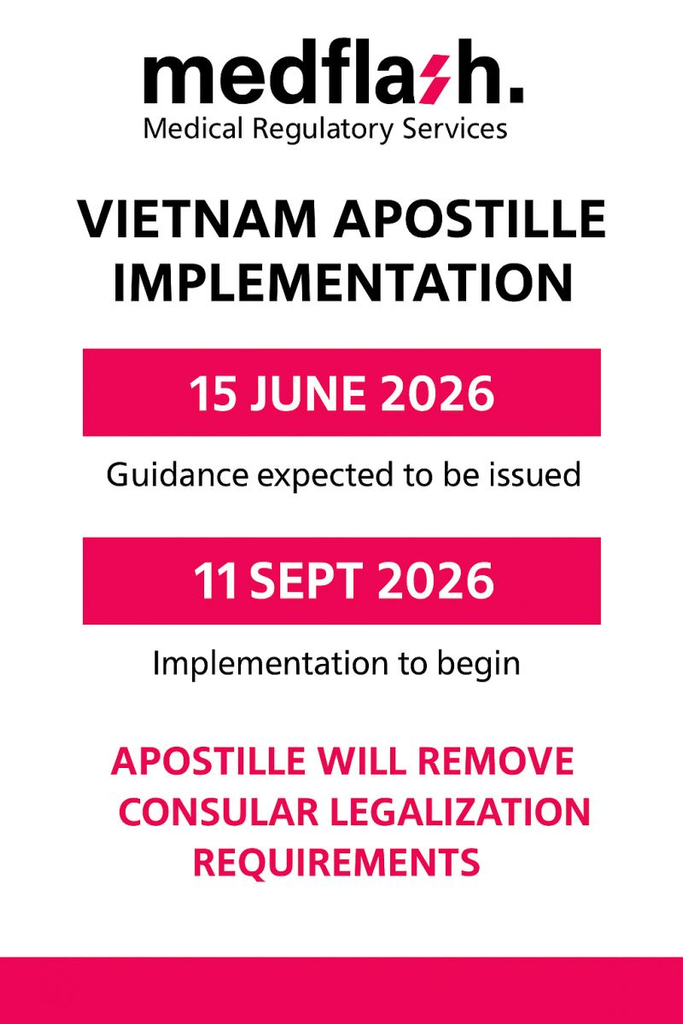
2️⃣ Legal Framework Development (Before 15 June 2026)
The Government will issue a Decree guiding the application of the Apostille Convention, including its implementation within the healthcare sector.
3️⃣ Apostille System Go‑Live (From 11 September 2026)
This is when the Convention officially enters into force for Vietnam. From this date, authorities must accept Apostille-certified documents without requiring consular legalization.
4️⃣ Decentralization to Local Authorities (2027–2030)
Provincial-level departments will gradually be empowered to issue Apostilles, making the process more accessible for citizens and businesses.
Impact on Healthcare, Pharmaceutical, and Medical Device Registration
✔ No more consular legalization for Apostille documents Starting 11 September 2026, the Ministry of Health and all Vietnamese authorities cannot request consular legalization for documents issued by Apostille member states. This directly benefits documents such as: – CPP / FSC – GMP certificates – ISO 13485 – LoA…
✔ Significant reduction in registration timelines and cost This change will: – Save weeks to months previously spent on consular legalization – Reduce administrative and courier costs – Prevent dossier rejections due to missing legalization stamps
✔ Strong alignment with global regulatory standards Vietnam will join 129 Apostille member states — including the US, Japan, EU, Canada, Australia — improving harmonization and easing global regulatory workflows.
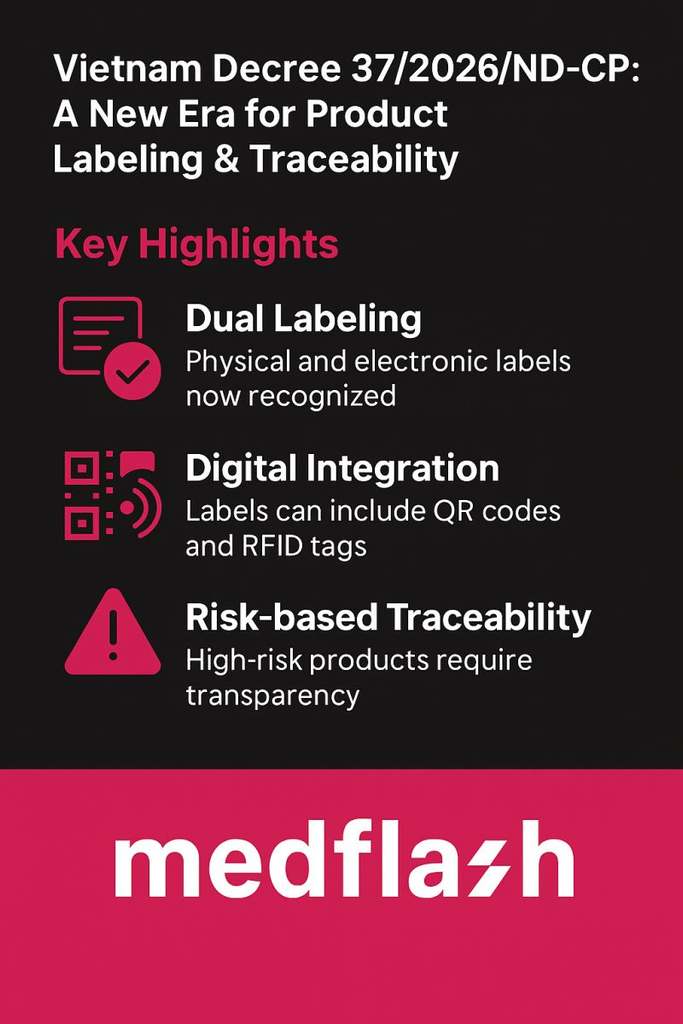
Vietnam’s latest decree reshapes how businesses must think about product labels and compliance.
🔑 Key Highlights
1️⃣ Dual Labeling: Physical labels remain mandatory, but electronic labels (E‑labels) are now officially recognized. 2️⃣ Digital Integration: Labels can embed QR codes, RFID tags, and barcodes to provide instant access to product data. 3️⃣ Risk‑based Traceability: High‑risk products must adopt traceability systems, ensuring transparency across the supply chain. 4️⃣ Medical Devices: Original and supplementary labels remain unchanged. However, traceability obligations will depend on the Ministry of Health’s forthcoming list of high‑risk devices.
💡 What This Means for Industry
Prepare to integrate digital traceability tools into your workflows. Monitor upcoming guidance from the Ministry of Health to understand which medical devices fall under “high‑risk.” Early adoption of QR/RFID‑based systems could position companies ahead of compliance deadlines.
👉 Medical device manufacturers, distributors, and healthcare providers should start evaluating their labeling and IT infrastructure now. The regulatory landscape is shifting—those who adapt early will lead the market.
Great news for the Medical Device industry! The Government has just issued Decree No. 26/2026/ND-CP, and it’s a game-changer for how we manage chemicals in healthcare.
For years, the MedTech sector has navigated complex, overlapping regulations. This new Decree brings much-needed clarity and efficiency by confirming that the Ministry of Health (MOH) is the sole responsible authority for chemicals used in: ✅ Medical Devices ✅ In Vitro Diagnostics (IVDs) ✅ Medicinal Products ✅ Other MOH-regulated goods
Why is this a big deal for our industry?
1️⃣ Goodbye Regulatory Overlap: No more juggling conflicting requirements between the Ministry of Industry and Trade (MOIT) and the MOH. One authority means one set of rules.
2️⃣ Faster Market Access: By removing duplicative approval layers, we can expect reduced lead times for importing and distributing essential medical technologies.
3️⃣ Supply Chain Certainty: Policy clarity directly translates to lower risk for manufacturers and distributors, ensuring that life-saving products reach patients without unnecessary bureaucratic delays.
4️⃣ Cost Efficiency: Streamlined compliance procedures mean lower administrative costs, allowing companies to focus resources on innovation and patient care.
This is a landmark advocacy outcome that protects continued access to essential medical technologies while strengthening Vietnam’s regulatory framework.
A big step forward for the “Ease of Doing Business” in Vietnam’s healthcare sector🏥
Just before closing out the year, the Vietnamese Ministry of Health issued Circular 57/2025/TT-BYT on December 31, 2025. This critical document sets the stage for a new era in procurement, introducing detailed guidelines on classifying medical devices based on technical standards and quality.
Just before closing out the year, the Vietnamese Ministry of Health issued Circular 57/2025/TT-BYT on December 31, 2025. This critical document sets the stage for a new era in procurement, introducing detailed guidelines on classifying medical devices based on technical standards and quality.
While the Circular technically takes effect on February 15, 2026, full implementation for procurement applies from January 1, 2027. This gives manufacturers and distributors roughly one year to realign their strategies.
Here is an analysis of what this means for the market.
1. The Core Framework: The 6-Group Classification
The Circular categorizes medical devices into six distinct groups (Groups 1 through 6). The classification logic relies on two main pillars: Technical Standards and Country of Circulation.
Groups 1, 3, & 5 (The “Reference” Tier): These groups are reserved for medical devices that meet the technical standards chosen by the procuring entity and are authorized for circulation in specific “reference countries/territories” (typically nations with stringent regulatory bodies).
Groups 2, 4, & 6 (The “Non-reference” Tier): These include medical devices meeting technical standards that circulate in at least one country or territory outside the strict reference list.
The Domestic Advantage: A crucial provision in Article 3 states that medical devices manufactured in Vietnam are eligible to participate in all groups, provided they meet the technical and quality criteria.
2. The Strategic Pivot: The “Conformity” Clause
Perhaps the most analytical takeaway from Circular 57 is how it treats the Certificate of Conformity under Vietnamese regulations.
For Local Manufacturers: Achieving this certification is a gateway to higher group classifications. It is a clear policy move to prioritize and facilitate the growth of Vietnam’s domestic medical device industry.
For International Players: This creates a new barrier to entry for the top tiers. Foreign products wishing to compete in higher groups may now face the challenge of obtaining Vietnam-specific conformity certifications, rather than relying solely on international credentials.
3. Why the “Higher Group” Matters
While the Circular is new and specific implementation guidelines from the Ministry of Health (MoH) are still forthcoming, we can forecast several significant impacts for stakeholders who secure a spot in the higher groups (Groups 1 & 2):
🎯 Pricing Power: Higher classification generally correlates with a higher quality perception, potentially justifying higher ceiling prices in tender packages.
🎯 Bidding Versatility: A “cascading” eligibility is expected. For instance, if a major hospital allocates a 1 million USD budget with 70% reserved for Groups 1 & 2, devices in these top tiers can likely bid on those specific packages plus the lower-tier packages. Lower-tier devices cannot bid up.
🎯 Budget Allocation: Top-tier hospitals (Central and provincial levels) will likely allocate the lion’s share of their budget to higher-group devices to ensure quality.
🎯 Differentiation: This system naturally segments the market. High-tech, precision instruments will be funneled into higher groups, while general consumables and common devices may dominate the lower groups.
Key Dates to Watch
Effective Date: February 15, 2026
Mandatory Application Date: January 1, 2027
The Takeaway
Circular 57/2025/TT-BYT represents a push toward standardization and a significant boost for “Made in Vietnam” medical technology. For foreign manufacturers, the next 12 months will be critical for assessing regulatory strategies to ensure their devices remain competitive in high-value tenders.
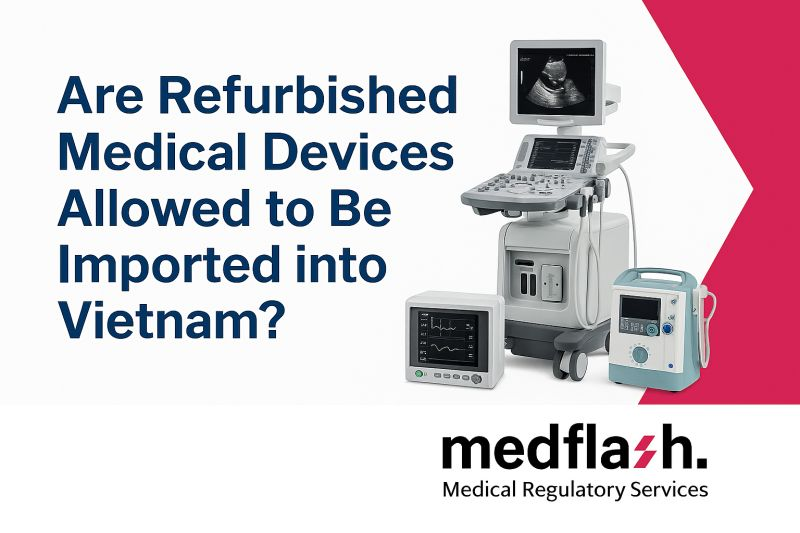
This is a common question from manufacturers and distributors exploring the Vietnam market. The short answer: not yet, in practice.
Vietnam has issued two Government Decrees that allow the import of refurbished (remanufactured) goods in principle, based on Free Trade Agreements: Decree 77/2023/ND‑CP (CPTPP) Decree 66/2024/ND‑CP (EVFTA & UKVFTA)
⚠️ However, these decrees are framework-level only. They confirm general eligibility but do not provide detailed import procedures. 🏥 For medical devices, implementation depends on guidance from the Ministry of Health (MoH). As of today, no MoH regulations have been issued covering: Registration of refurbished medical devices Import licensing and clearance Quality and compliance requirements
👉 As a result, refurbished medical devices cannot yet be imported into Vietnam, despite the FTA-based legal framework.
📌 Key takeaway: Refurbished medical devices are theoretically allowed, but not operationally feasible until the Ministry of Health releases specific implementing regulations.
Recently, the aesthetics industry has seen a familiar but costly scenario: A product marketed for years as suitable for mesotherapy (injection) was suddenly “clarified” by its local distributor—in writing—to be for topical cosmetic use only, as per its regulatory dossier.
From a consulting perspective, this exposes a structural risk many foreign manufacturers underestimate—the loss of regulatory control once licensing and market execution are fully delegated to a distributor.
When distributors: ❌ Push marketing beyond approved indications ❌ Allow off‑label use without transparency ❌ Rely on perception instead of documentation
Short‑term sales may rise—but brand trust quietly erodes. In the market’s eyes, your distributor’s message is your brand’s voice.
“Hands‑off licensing” reduces initial complexity but severely weakens risk control. Disclaimers may protect distributors—brand damage cannot be disclaimed.
That’s why leading manufacturers now: ❎ Hold licenses directly, or ❎ Appoint independent regulatory consultants as license holders
Distributors sell products. Regulatory control protects brands.
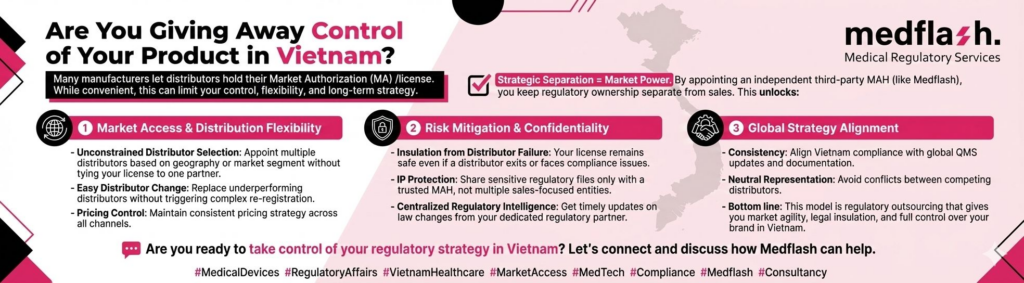
Are You Giving Away Control of Your Product in Vietnam?
Many manufacturers let distributors hold their Market Authorization (MA) /license. While convenient, this can limit your control, flexibility, and long-term strategy.
Strategic Separation = Market Power By appointing an independent third-party MAH (like Medflash), you keep regulatory ownership separate from sales. This unlocks:
1. Market Access & Distribution Flexibility – Unconstrained Distributor Selection: Appoint multiple distributors based on geography or market segment without tying your license to one partner. – Easy Distributor Change: Replace underperforming distributors without triggering complex re-registration. – Pricing Control: Maintain consistent pricing strategy across all channels.
2. Risk Mitigation & Confidentiality – Insulation from Distributor Failure: Your license remains safe even if a distributor exits or faces compliance issues. – IP Protection: Share sensitive regulatory files only with a trusted MAH, not multiple sales-focused entities. – Centralized Regulatory Intelligence: Get timely updates on law changes from your dedicated regulatory partner.
3. Global Strategy Alignment – Consistency: Align Vietnam compliance with global QMS updates and documentation. – Neutral Representation: Avoid conflicts between competing distributors. – Bottom line: This model is regulatory outsourcing that gives you market agility, legal insulation, and full control over your brand in Vietnam.
Are you ready to take control of your regulatory strategy in Vietnam? Let’s connect and discuss how Medflash can help.